Roundabout
A Prog Rock Odyssey with Yes

Roundabout by Yes is one of those tracks that you don’t just play; it unfolds.
It’s a rollercoaster of moods, textures, and sheer musical wizardry—and this is not close to the most complex from the legendary band.
This is a song that makes you feel like you’re floating through space one moment and racing down a highway the next.
As with many of my introductions to rock classics like this one, I was just a kid when I stumbled upon this track, thanks also to a friend of mine. I didn’t know much about Yes or progressive rock at the time; I was much into heavy metal and other stuff these days—I just knew it was and sounded different.
Yet the first time I heard that opening riff, it felt like someone had just opened a portal to another world. That crisp, bouncy acoustic guitar line, followed by a deep, swirling bassline—it was unlike anything else. It wasn’t just rock; it was a journey.
It was my opening to a long venture into prog rock.
But before we dive into the magic of this special track, let’s talk about the masterminds that made this and other wonders possible.
The Band That Built the Soundscape
Yes, Yes was never just a rock band. Get the pun?
No, but really, they were not just musicians but sonic architects, layering sounds in ways that made you hear new things even after a hundred listens. And on Roundabout, every member brought something irreplaceable to the table.
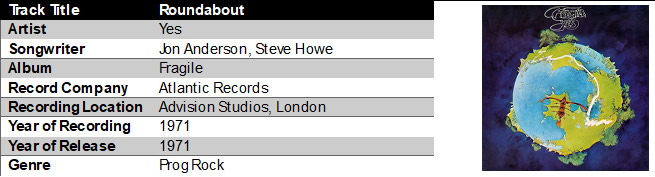
Part of their fourth album titled Fragile, released in 1971, the track became one of their most iconic ones.
Formed at the time by:
Jon Anderson on vocals
Steve Howe on guitar
Chris Squire on bass
Rick Wakeman on keyboards
And Bill Bruford on drums
They formed an absolutely solid lineup, each one with an unmistakable style—this was the first Yes album to feature Rick Wakeman, whose keyboard work became a defining element of their sound.
Steve Howe’s intricate guitar work, Chris Squire’s monster bass tone, and Wakeman’s keyboard flourishes that felt like they were beamed in from the future—it all combined into something surreal. Putting their mark on what would become the legendary era of progressive rock.
A Song That’s More Than Just a Song
Roundabout isn’t your typical rock track; it’s an experience. From that unforgettable acoustic intro to the soaring vocals and shifting time signatures, it keeps you engaged and intrigued from start to finish.
It has this organic, almost hypnotic rhythm to it, with moments where the bass and guitar seem to be dancing around each other, building tension before exploding into pure, melodic bliss. And then, of course, there’s Wakeman’s keyboard work, which feels like it’s narrating some epic sci-fi adventure.
And let’s not forget those lyrics, abstract, poetic, and dreamlike. Jon Anderson wasn’t just writing about a road trip; he was painting with words. Every line feels like a brushstroke on a surrealist canvas. Not surprising from a song from the seventies.
1971: A Year of Musical and Cultural Shifts
The early ‘70s were a time of major changes in music and culture.
Rock was evolving rapidly—psychedelic influences were giving way to more experimental and intricate styles, and progressive rock was taking shape. Bands like Yes, Genesis, and King Crimson were pushing the limits of what rock could offer, blending classical music structures with modern electric sounds and other genres.
Also in 1971, Led Zeppelin released their legendary fourth album, featuring Stairway to Heaven. The Rolling Stones were on fire with Sticky Fingers. Meanwhile, Pink Floyd was crafting Meddle, hinting at the progressive brilliance that would soon explode with Dark Side of the Moon.
On the other hand, outside of music, the world was shifting too.
NASA launched the Apollo 14 mission, sending astronauts to the moon once again. The Vietnam War was still raging, and protests were becoming even louder.
In pop culture, Willy Wonka & the Chocolate Factory hit theaters, delighting audiences with its psychedelic weirdness.
Amidst all this, Yes was carving out their own space in rock history, releasing Fragile and forever changing the landscape of progressive rock. "Roundabout" wasn’t just a hit—it was a defining moment in a genre that thrived on complexity, artistry, and pushing boundaries.
An Actual Roundabout
Over 50 years later, "Roundabout" still sounds fresh. It’s a song that embodies everything that made progressive rock great—creativity, technical brilliance, and a fearless approach to songwriting.
It’s the kind of track that keeps revealing new details every time you hear it. And that’s what makes it legendary.
If you haven’t listened to Roundabout yet, or in a while, do yourself a favor—put on some good headphones, close your eyes, and let Yes take you on a journey once again.
🎵 What’s your favorite Yes song? What does this song make you feel?
Track Info: