
Fearless
A Psychedelic Hymn That Whispered Pink Floyd’s Next Big Leap

Some songs walk right up to you and demand attention. Others? They sit quietly in the corner, strumming a riff that somehow finds its way under your skin before you realize what’s happening. Fearless by Pink Floyd is firmly in that second camp.
It’s not a track that’s ever been the face of the band. You won’t find it on greatest hits compilations or blasting from stadium speakers. But that’s exactly why it stands out.
Nestled in the middle of 1971’s Meddle album, it feels like a secret handshake between the band and the listener, a melodic whisper that says:
Hey, come closer. You’re going to want to hear this.
That Opening Riff? It’s a Wave
From the moment Fearless begins, you’re not dropped into psychedelia in the usual Floyd fashion—no sci-fi effects, no heartbeat pulses, no disembodied voices. Instead, you get this clean, slow-burning acoustic guitar riff that climbs up and up. And then it starts again. And again.
It’s hypnotic in the most pastoral way. Like a lazy tide, gentle but unstoppable. That riff doesn’t need to flex; it trusts you’ll come along for the ride.
David Gilmour’s playing here?
Deliberate and understated. It’s not about fireworks; it’s about the feel. This is the sound of a band choosing melody over madness, clarity over chaos, and yet somehow, the song still floats in a haze. Like a lucid dream where everything’s real, but slightly… shinier.
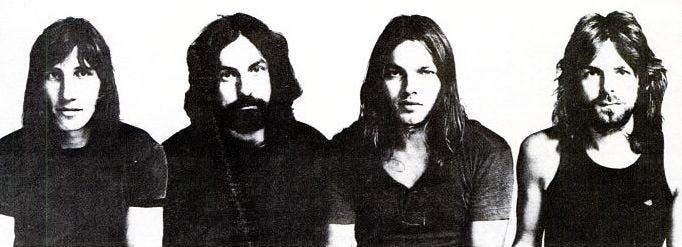
Fearless. Band Lineup (from Meddle, 1971)
David Gilmour. Lead vocals, acoustic and electric guitars
Roger Waters. Bass guitar, co-writer, backing vocals
Richard Wright. Keyboards, piano, backing textures
Nick Mason. Drums and percussion
Psychedelic Hangover, Meet Prog Rock Dawn
And here’s why Fearless is such a landmark to me: it’s the ghost of Floyd’s acid-fueled past waving goodbye while also cracking the door to the shimmering cathedrals of Wish You Were Here and Animals.
There’s no denying that the song has roots in psychedelia—you can hear it in the loose atmosphere, in how time seems to stretch out as it plays—but it's more grounded than anything from their Syd era. Yet, at the same time, it hints at what’s coming: the precision, the emotional depth, and the slow-building narrative arcs of their classic '70s masterpieces.
In short: Fearless is Floyd looking in both directions at once… And somehow, it works beautifully.
Gilmour and Waters in Harmony (Literally and Figuratively)
Vocally, Fearless is a warm, human moment in the Floyd catalog. David Gilmour and Roger Waters harmonize in a way that feels almost... brotherly.
You don’t get that dynamic too often; this wasn’t Lennon/McCartney, after all. Their personalities would later fracture the band, but here? You feel unity.
The lyrics themselves are deceptively simple.
“You say the hill's too steep to climb... chiding
You say you'd like to see me try... climbing.”
This is a song about defiance without bravado.
This is about facing a world that tells you, “You can’t,” and whispering back, “Watch me.” It’s a quiet kind of courage. Fearless, indeed.
The Sound of the Early Seventies
Let’s talk a little about the era.
In 1971, the counterculture was still smoldering, but the revolution felt somehow... introspective. The '60s idealism had curdled into disillusionment, and artists started turning inward. You can hear it in Neil Young’s After the Gold Rush, in the weary brilliance of Who’s Next, in the cosmic resignation of Aqualung.
Pink Floyd was no exception. After the chaos of Ummagumma and the explorative jam sessions of Atom Heart Mother, they needed focus. Meddle provided that, and Fearless, in particular, offered a moment of warmth, reflection, and clarity that felt completely of the time but also timeless.
It’s rock stripped of ego, psychedelia stripped of artifice, just melody and message.
And then… You’ll Never Walk Alone?
Right when you think the track is gently fading out, you get hit with one of the strangest and most beautiful left turns in Floyd’s discography: a crowd—chanting, singing, roaring—through the speakers; that’s Liverpool FC’s anthem, You’ll Never Walk Alone.
It’s not ironic. It’s not mocking. It’s communal.
Suddenly, this intimate, acoustic meditation becomes something bigger, more anthemic; the lone voice gains an army.
Some have debated the meaning of the outro for years—was it a nod to unity? A working-class solidarity shout-out? A jab at British football culture? I’d say it doesn’t matter. What matters is how it feels. Triumphant. Resolute. Uplifting.
It turns Fearless from a song about personal defiance into a hymn about collective strength.
Why It Still Hits… With Me
When I think of Fearless, I think of how quiet strength can be: no shredding solos, no complex time signatures, just a song that climbs slowly and steadily like a mantra, like someone who’s been knocked down more times than they can count but still gets up every time the bell rings.
It’s a song I come back to when I’m feeling unsure. When I need to remember that there’s bravery in simply trying again.
There’s a reason Fearless has aged like fine scotch. It wasn’t trendy, it wasn’t built for charts, it was built for you, the listener. And not just to hear, but to feel.
And it’s Still Floyd
Pink Floyd has plenty of towering, cosmic, genre-defining tracks. But Fearless is something else. It’s the soulful pause before the storm.
It’s the psychedelic embers cooling off into prog rock steel.
It’s melodic power, not through force, but through presence.
And for me, it’s one of the most underrated gems in their catalog.
So, next time you’re climbing a hill—figurative or otherwise—put on Fearless, and let the guitar loop wrap around you like sunlight. Let the chant remind you you’re not alone, and remember:
It’s not about making it to the top first. It’s about making the climb with your head held high.
🎵 So, what’s your favorite “underrated Floyd” track?
Drop a comment, and let’s trade deep cuts. You know I’m always game for a headphone journey.
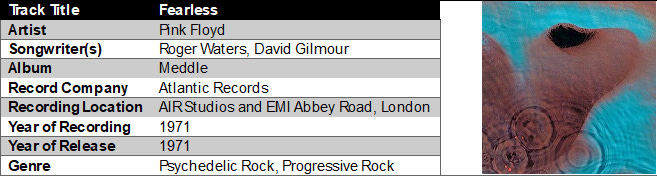
Track Info:
🎧 Listen on: